 AI-Fluence
Every page AI read, and what you can do about it
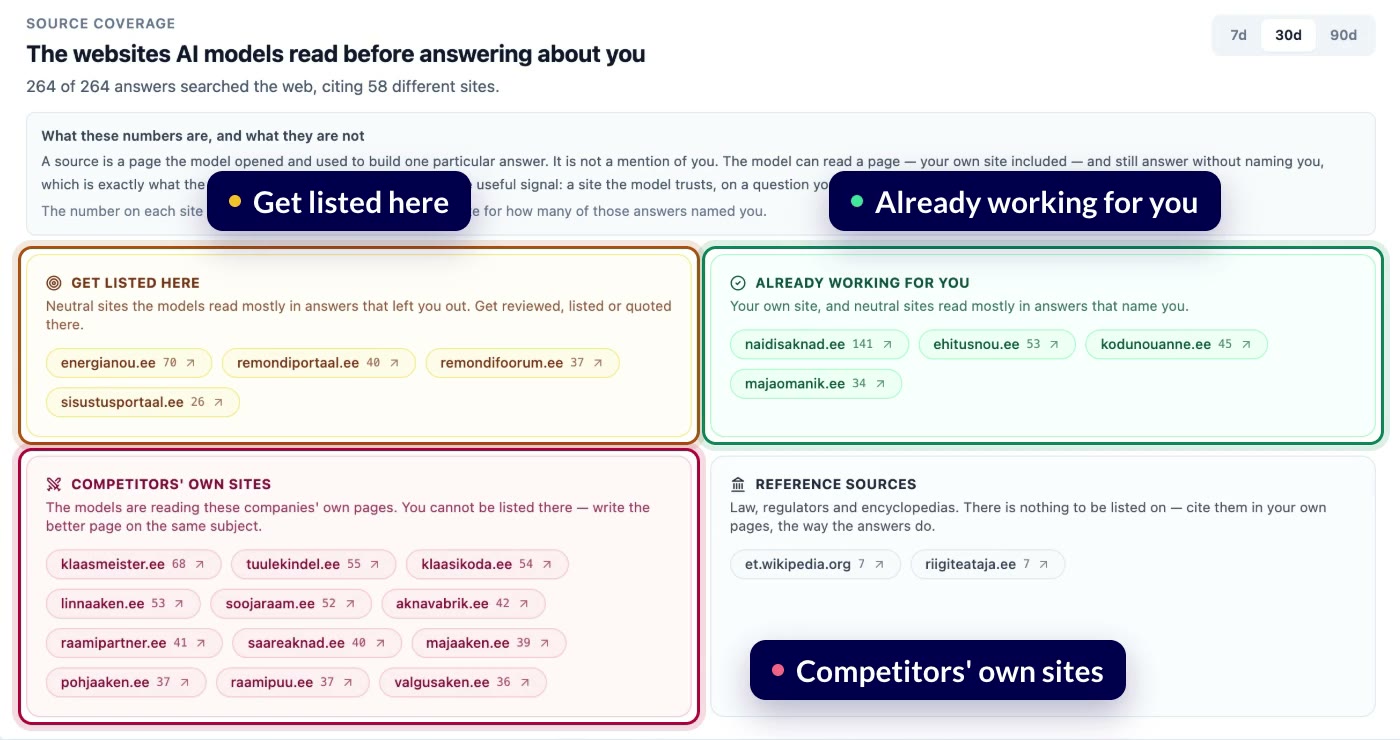
Answering with web search, an assistant reads pages and cites them. AI-Fluence records those AI search sources, sorts them into four groups and tells you, for each group, which work changes the answer there.
- The cited pages from every answer
- Four groups, each with its own fix
- The exact page, not just the domain
Where an answer comes from
When ChatGPT, Claude or Gemini answer with web search, they lean on the pages they just read. Those pages decide who gets named. Every round records every cited page and ties it to its answer: did that answer name you, or leave you out.
For each domain you see the exact pages that were cited, most cited first. A task that says “get onto this site” is only doable when you know which article the assistant read. The site’s home page is often something else entirely.
Four groups and what to do with each
| Group | What they are | What to do |
|---|---|---|
| Worth getting onto | Neutral pages read in answers that leave you out: a comparison, a review, a forum | Get listed, reviewed or quoted there |
| Already working for you | Your own pages and sites read in answers that name you | Keep them current |
| Competitors’ pages | Companies’ own sites, mostly your competitors’ | Write a better page on the same subject |
| Associations and registers | Laws, regulators, registers, trade bodies, encyclopedias | Cite them on your own pages |
In three of the four groups the fix is not “write more content”. That is why a content plan alone is not enough.
Worth getting onto
The most useful group. The assistants read these pages in answers that leave you out, and they belong to nobody you compete with. A comparison site, a review site or a forum thread will often take you in if you ask or write. At the top are the pages read most often and where a mention is the shortest road to a recommendation. For Reddit and Quora threads we draft the reply for you, see Reddit and Quora.
Competitors’ pages, associations and registers
Nobody adds you to a competitor’s site. When an assistant cites a competitor’s guide or price page, the answer is a better page on the same subject, and those topics go into the content engine plan. The competitors view shows which questions that page wins.
Nobody lists themselves in a register or on an official page either. Those are the sources your pages should cite, and the content engine uses them when checking facts.
Sources become the week’s task list
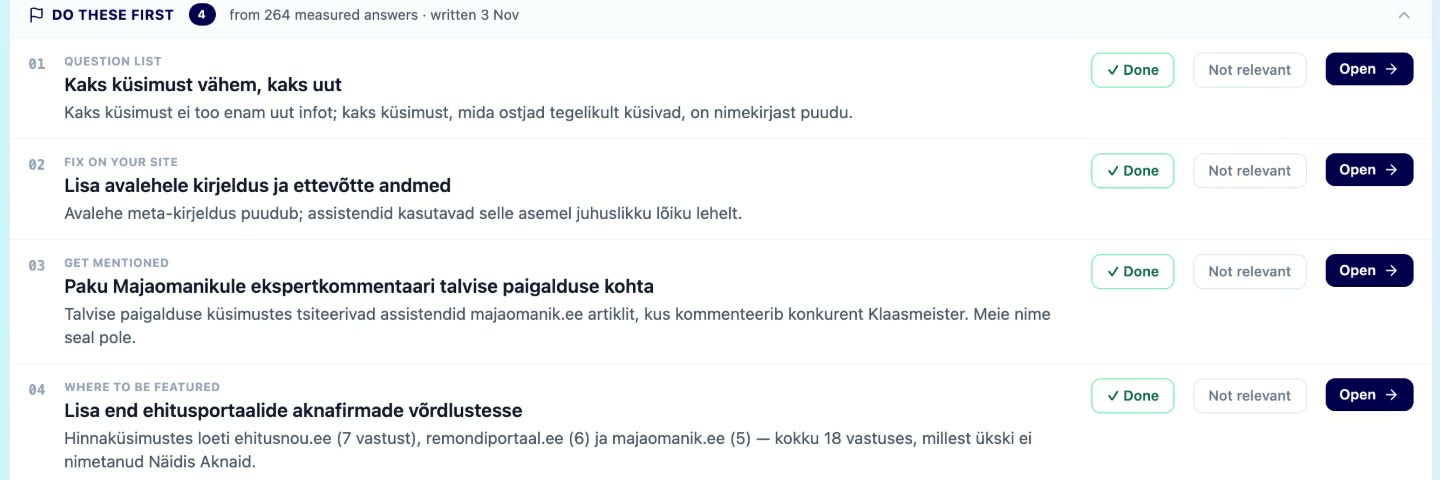
After every round a model reads the sources and answers and writes down the few things that would change them: which page to get onto, what to fix on your own page. Each task carries the measurements it rests on, so you can judge for yourself whether it is for you.
Frequently asked questions
Do all assistants show their sources?
When they answer with web search they cite the pages they read, and we record those. An answer given without search has no sources, and you see that in the numbers too.
Why show competitors’ pages if I cannot get onto them?
Because they tell you which page you are missing. The fix is a better page on the same subject on your site, not an attempt to get listed there.
Do you contact comparison sites for us?
No. We show the exact page the assistants read and why it matters. You make the contact, because that relationship stays yours.
Further reading
See also
See what AI says about you today
The first round shows where you stand, before anything is written.