 AI-Fluence
Articles for the questions where you are missing
Measurement shows which questions AI answers without naming you. The content engine turns those gaps into a content plan, writes the articles and publishes them on your site once you approve.
- Topics come from the measurements, not a keyword list
- Facts from your own site, sources checked
- WordPress, or our blog on your subdomain
Topics come from the answers
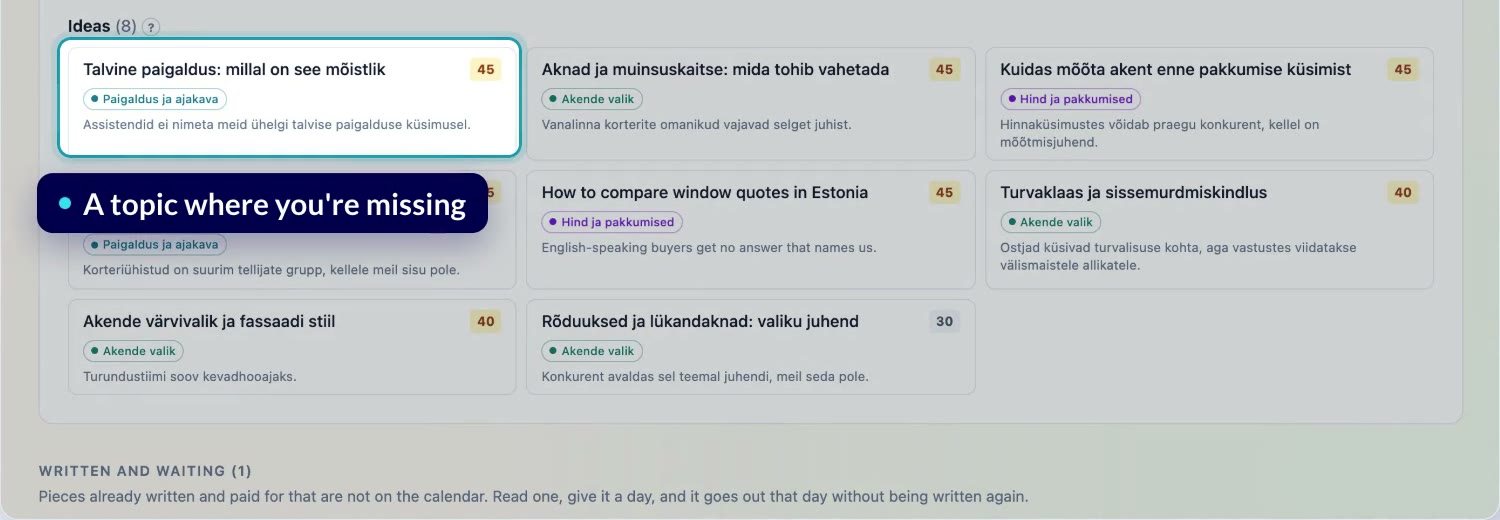
The content plan does not start from a keyword sheet. It starts from the questions where ChatGPT, Claude and Gemini name others and not you, and from the pages they read there. If an assistant cites a competitor’s guide, the plan gets a topic your site has no answer to. Every topic shows the measurement it came from.
So the content engine does not just write more content. It writes a page meant to change the answer to a specific question for AI search, and the following rounds show whether it did.
What is in an article
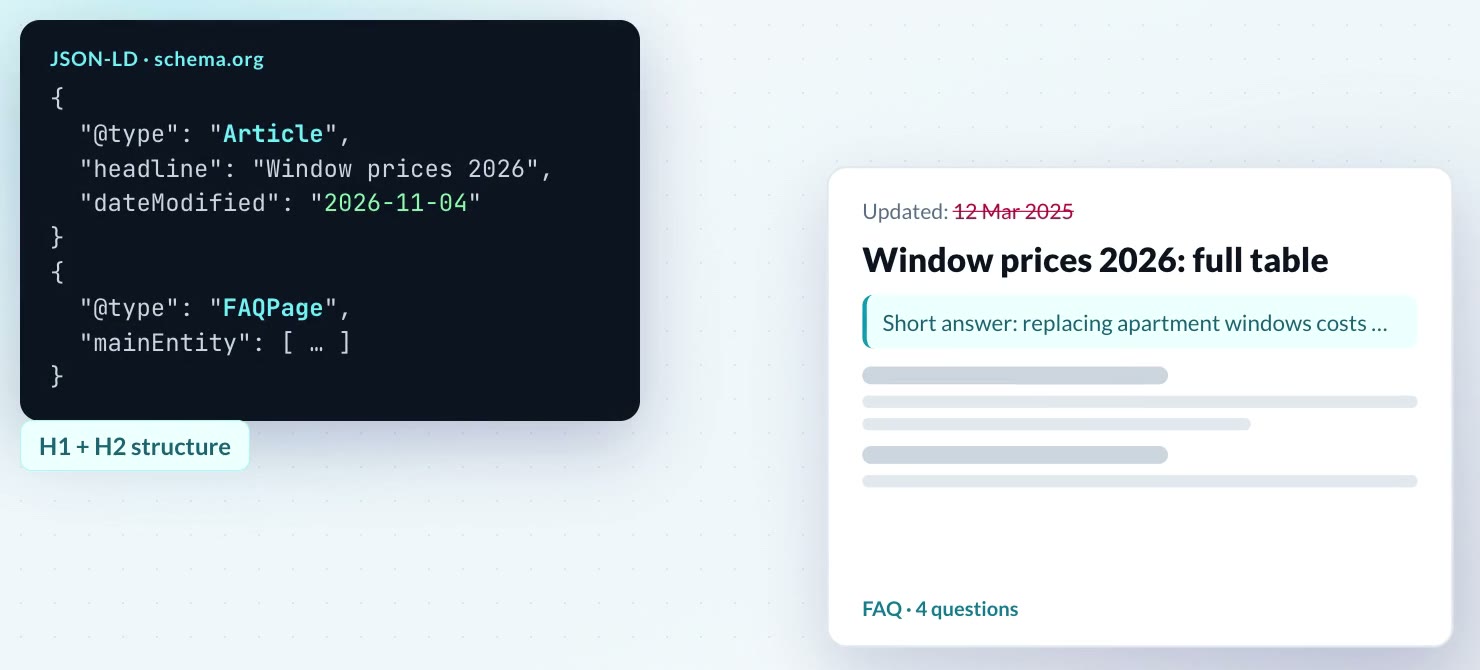
An assistant does not rank pages, it quotes them. So every article carries parts that can be lifted off the page intact:
- a quick answer right at the top, two or three sentences that stand on their own;
- key takeaways as full sentences, each quotable alone;
- a table a machine can read without going through the prose;
- frequently asked questions and schema markup.
Facts come from your site and from sources that have been checked. A thin or fact-free article fails the quality check and is not published.
You approve, or switch on automatic publishing
By default every article waits for your approval. You get one note that an article is waiting and a reminder on the publishing day. Read, edit and approve with one button, and choose whether the piece goes to its own section or the main blog. If you trust the plan, switch on automatic publishing in settings. Publishing runs at a steady pace, never in bursts. You see the content plan month by month: what is published, what awaits approval and what is still planned.
Where articles go
| Your site | How to connect |
|---|---|
| WordPress | One plugin and a key. We also fill in the Yoast, Rank Math or SEOPress fields. |
| Another platform | Our blog on your subdomain, for example blog.yoursite.com. You add one DNS record; we handle the certificate. |
Articles are written in the language your buyers ask in: English, Estonian or Russian.
An article does not go stale
Every published article is reviewed once a quarter: dead sources, outdated numbers. Assistants read old pages too, and a wrong price or a broken link makes a page unfit to quote. The work an article cannot do, such as pages worth getting onto, stays on the weekly task list. How it all adds up to generative engine optimization is on its own page.
Frequently asked questions
Are articles published without my approval?
Only if you want that. By default every article waits for your approval, and automatic publishing can be switched on in settings.
My site is not on WordPress. Does it work?
Yes. We publish the articles on our blog under your subdomain. You add one DNS record; we handle the certificate.
Will AI-written content hurt us in Google?
Mass-produced content without facts does. That is why we write few articles, publish at a steady pace, check sources and hold back any article that fails the quality check.
How soon does an article change the AI’s answer?
No page changes the answer on the day it goes up. The rounds ask the same questions every week and show when the change comes, if it does.
See also
See what AI says about you today
The first round shows where you stand, before anything is written.